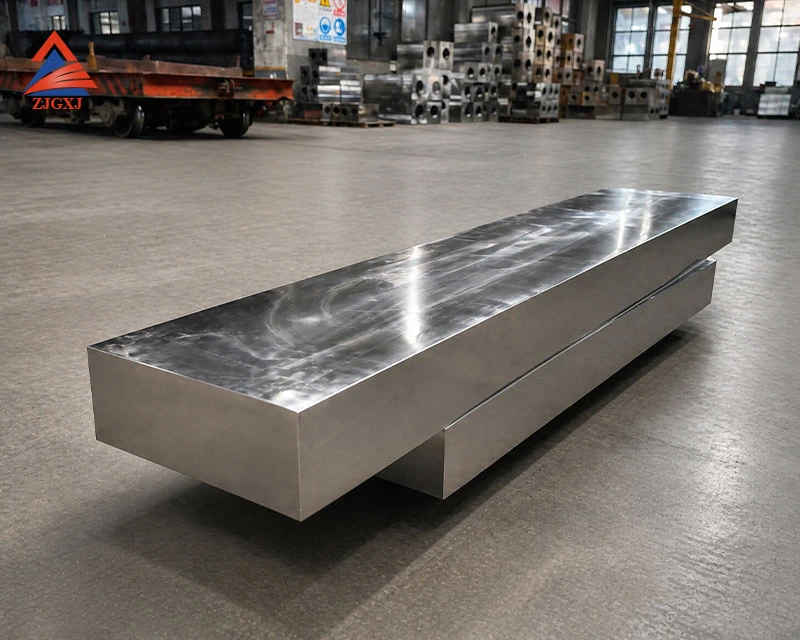
If you've ever watched a metal forging press crush red-hot steel into a car crankshaft, a farm equipment gear, or a construction component, you might have wondered what makes the die that shapes that metal durable enough to handle thousands of repeated hits. As a supplier specializing in forged die inserts, I get this question at least twice a week from new forging operators, die designers, and even fellow industry folks who want to level up their tooling performance. The short answer is: it depends on the application, the material being forged, the number of cycles required, and the specific challenges the die will face (like extreme heat, impact, wear, or corrosion). But the long answer is a deep dive into steel metallurgy, material science, and the real-world tradeoffs that separate a die insert that lasts 1,000 cycles from one that outlasts an entire production line. Let's break down the most common materials, why they work, and when you'd choose each one, along with how our work ties into the broader landscape of Die Steel Forging.
First, it's important to clarify what a forged die insert is, for anyone new to the space. Unlike a full forged die block, which is a large, monolithic tool that makes up the entire die structure, a forged die insert is a smaller, interchangeable component that fits into a die holder. These inserts are the "working end" of the die-they're the part that comes into direct contact with the hot, deforming metal, so their material is critical to performance and cost efficiency. Why use inserts instead of a single die? Because when an insert wears out or cracks, you only replace the insert, not the entire die, which cuts down on downtime and tooling costs by 50% or more for most mid-sized forging runs. If you're looking for more context on how these inserts are manufactured, our page on Forged Die Insert goes into the forging and machining process that turns raw steel into precision-fit tooling.
Now, let's get to the core materials. The most common base for forged die inserts is tool steel, a category of high-performance steels engineered for hardness, toughness, and resistance to the specific stresses of forging. But not all tool steels are created equal-each type is tailored to a different set of conditions. Here are the four most widely used grades for die inserts, plus a few emerging options for extreme applications.
The first, and most versatile, is hot work tool steel. This is the workhorse of the forging industry, designed specifically to perform at the high temperatures generated during forging. When you forge metal, the surface of the die can reach 1,000°F or higher, and hot work steels are formulated to retain their hardness at those temperatures (a property called red hardness). The two most common hot work grades are H11 and H13. H11 is a mid-alloy steel with good toughness and wear resistance, ideal for medium-stress forging applications like aluminum alloy parts, small steel fasteners, and brass components. H13 is a higher-alloy variant, with extra chromium and vanadium that make it stronger, more wear-resistant, and more stable at higher temperatures. That makes H13 the go-to for most high-volume steel forging, from automotive parts to agricultural equipment. I've seen H13 inserts last up to 100,000 cycles in production for a major heavy equipment manufacturer, as long as they're maintained properly. If you're working on a general-purpose forging line, hot work tool steel is almost always your first call, and it's the base material for most of the inserts we produce. For those who want to understand how this steel is processed into usable tooling, our Mold Steel Plate Forging page explains the steps from raw steel billet to precision-machined plate that's often used to cut die inserts from.
Next, for applications that demand even higher wear resistance than hot work tool steel, we turn to cold work tool steel. Wait, you might be thinking-cold work steel? How does that work for forging, which is hot? The key here is that cold work steels are used when the wear comes more from abrasion than from heat. For example, when forging metals like stainless steel or titanium, both of which are extremely abrasive and tend to gall (stick to the die surface) at high temperatures, cold work steels like D2 and S7 can hold up better than hot work grades. D2 is a high-carbon, high-chromium steel with exceptional wear resistance, perfect for forging parts with sharp edges or tight tolerances that require minimal material loss over thousands of cycles. S7, on the other hand, is a shock-resistant cold work steel, used for forging parts that experience sudden, heavy impact, like large gear blanks or construction hardware. The tradeoff with cold work steels is that they're more brittle than hot work steels, so they're not ideal for applications where the die is subject to thermal shock (like sudden temperature changes from spraying coolants to prevent overheating). But when used correctly, they can double the lifespan of inserts in high-wear forging jobs.
For the most extreme forging applications-think of forging titanium alloys, superalloys used in aerospace or power generation, or large steel ingots that require millions of cycles-we turn to specialized premium alloys, like powdered metallurgy (PM) tool steels or high-speed steels. PM steels are made by melting the alloy components, atomizing them into fine powder, then compacting and sintering the powder into a solid billet. This process creates a more uniform, fine-grained structure than traditional forged steel, which means better toughness, wear resistance, and resistance to thermal fatigue (cracking from repeated heating and cooling). The most popular PM die insert steel is ASP 2023, a high-alloy steel with exceptional red hardness and wear resistance. I recently worked with an aerospace forging company that was switching from H13 inserts for titanium turbine blisks; their old H13 inserts were cracking after 20,000 cycles, but ASP 2023 inserts are still going strong after 120,000 cycles. The downside? PM steels are 20-30% more expensive than conventional hot work steels, so they're only justified for high-margin, high-volume applications where downtime costs are enormous. Another specialized option is nickel-based superalloys, used for forging the most heat-resistant metal parts, though these are rare and reserved for very niche, high-stakes jobs.
Wait a second-what about materials that aren't steel? For small, low-volume forging runs, or for forging non-ferrous metals like aluminum, copper, or brass, we sometimes use alternative materials like copper alloys or graphite. Copper-chromium-zirconium (CuCrZr) alloys have excellent thermal conductivity, which means they dissipate heat much faster than steel inserts-critical for forging aluminum, which tends to stick to hot steel dies. Graphite inserts are even more thermally conductive and lightweight, making them easy to machine and perfect for forging intricate aluminum parts where surface finish is key. The tradeoff here is that copper alloys and graphite are much softer than steel, so they don't last nearly as long-graphite inserts might only last a few hundred to a few thousand cycles, compared to tens of thousands for steel. So these are best for prototyping, low-volume runs, or parts where surface quality is more important than cycle life.
Now, let's talk about how material choice ties into the broader forging ecosystem, because a die insert is only as good as the die it's paired with, and the overall forging process. A lot of new operators make the mistake of buying the cheapest steel insert they can find, only to run into problems like premature wear, cracking, or poor part quality. For example, using a low-grade H10 hot work steel (a cheaper, lower-alloy variant of H13) for a high-volume steel forging run might save you 10% on the insert up front, but it will wear out in 20,000 cycles, leading to 10 more insert changes per month, 4 hours of downtime per change, and thousands of dollars in lost production. On the flip side, using an expensive PM steel insert for a low-volume aluminum forging run is just throwing money away- a CuCrZr insert will work just as well, for a fraction of the cost. That's why we work closely with our customers to assess their specific needs: what are they forging? How many cycles do they expect? What's their downtime cost? What's their budget?
If you're new to sourcing die inserts, it's also important to understand that the material isn't the only factor in performance-how the insert is forged and heat-treated matters just as much. A H13 insert that's improperly heat-treated (too soft, or too hard) will fail just as quickly as a D2 insert used for the wrong application. That's why our process at our facility starts with selecting the right raw steel, then forging it into the shape of the insert using controlled, consistent Die Steel Forging processes that refine the grain structure and eliminate defects. Our Forged Die Block page has more details on how our forging operations ensure uniform material quality across large die components, which translates directly to more reliable inserts.
Let's also touch on common mistakes we see our customers make when choosing insert materials. One big one is not accounting for thermal fatigue. When a die goes from 1,000°F after forging to room temperature when it's sprayed with coolant to prepare for the next cycle, it expands and contracts rapidly. Steels with low thermal shock resistance (like high-alloy cold work steels) will crack under this stress over time. Another mistake is choosing a material with too much wear resistance and not enough toughness. For large forging jobs where the die is subject to heavy impact, a brittle D2 insert will crack far faster than a slightly softer, tougher H11 insert, even though D2 is more wear-resistant. It's all about balance.
Looking ahead, the materials used for forged die inserts are evolving as the forging industry shifts to higher volumes, more complex parts, and more sustainable production. There's a growing demand for insert materials that are more durable, easier to recycle, and optimized for new metals like advanced aluminum alloys and sustainable steel grades. I've been working with a team of metallurgists to develop a new type of hot work steel alloy that retains hardness at higher temperatures and is more resistant to corrosion, which will help our customers reduce insert changes in high-volume stainless steel forging. The future of die insert materials isn't just about stronger or harder-it's about smarter, tailored materials that solve specific pain points for each application.
At the end of the day, the material you choose for your forged die insert will have a direct impact on your production costs, downtime, and part quality. Whether you're running a small prototype forging line or a large aerospace production facility, there's a material that's right for your needs. If you're tired of inserts that wear out too fast or fail unexpectedly, or if you're just looking to optimize your tooling for better performance, feel free to reach out to us to discuss your project. We'll help you select the right material, work with our forging team to manufacture precision inserts, and support you with maintenance and troubleshooting to maximize your die life.