

If you've ever stood beneath a wind turbine on a gusty day, watching the enormous blades spin slow and steady enough to count, you might've wondered how that slow, powerful motion turns into the fast, precise rotation needed to generate electricity. The answer lies largely inside the turbine's gearbox, and at the heart of that gearbox is a critical component I've spent over a decade sourcing and supplying: the wind turbine ring gear. When I first started in this industry, I assumed ring gears were just simple, toothed metal circles-turns out, their speed ratio isn't a random number. It's the backbone of how wind energy gets converted into usable power, and understanding it has shaped everything I do as a supplier.
Let's start with the basics, no fancy jargon (I learned early on that overcomplicating things scares off both new energy engineers and small wind farm operators). A standard utility-scale wind turbine has blades that spin at 10 to 20 rotations per minute (RPM) in moderate wind. But the generator that makes electricity needs to spin at 1,000 to 1,800 RPM-70 to 180 times faster than the blades. That jump doesn't happen on its own. The gearbox holds a series of gears, and the ring gear is the largest, outermost gear that pairs with smaller pinion gears to multiply speed. The speed ratio of the wind turbine ring gear is the exact measure of that multiplication-how many times the pinion gears spin for every single rotation of the ring gear.
Wait, hold on-let's get specific here, because this is where a lot of people mix up terminology. The ring gear in a wind turbine gearbox is an internal gear, meaning its teeth face inward, rather than outward like a standard car transmission gear. That's not just a design quirk: internal gears fit more compactly, handle higher torque (the twisting force that moves heavy loads) without bending, and deliver a more predictable speed increase. Speed ratio for any gear set is calculated by dividing the number of teeth on the driven gear by the number of teeth on the driving gear. For a ring gear and pinion pair, that means if the ring gear (driven) has 150 teeth and the pinion (driving) has 15 teeth, the ratio is 150/15 = 10:1. But most wind turbine gearboxes don't just have one stage-they have two or three sets of gears, so the total ratio is the product of each stage's individual ratio. A typical three-stage gearbox might have total ratios between 80:1 and 100:1, with the ring gear contributing between 20:1 and 30:1 of that total.
I've seen firsthand why getting this ratio right makes or breaks a turbine's performance. Early in my career, I worked with a small wind farm in the Midwest that installed a new turbine with a mis-sized ring gear. The manufacturer had cut corners on custom machining, so the ring gear's tooth count was off by just 2. That tiny error threw the speed ratio off by 12%, and the turbine never hit its rated power output-losing the farm an estimated $18,000 in annual revenue, per their utility reports. That's when I realized: ring gears aren't a one-size-fits-all part, and their speed ratio isn't a generic number. It's tailored to every turbine's blade design, gearbox configuration, and even the average wind speed of the farm's location.
Let's break down how that ratio is calculated for a specific turbine, because it's not as abstract as it sounds. Take a common 2.5 MW onshore turbine: blades spin at 12 RPM, needs a generator speed of 1,200 RPM. Total speed ratio needed is 1,200 / 12 = 100:1. Now, split that into stages: first a planetary stage (which includes the ring gear), then two parallel shaft stages. The planetary stage (the stage with the wind turbine ring gear) usually delivers a ratio of around 30:1. That means the ring gear in that planetary set has roughly 120 teeth, paired with a pinion of 4 teeth-120 divided by 4 is 30, exactly. If the wind farm is in a low-wind area (average 5 m/s instead of 7 m/s), we might adjust the ratio to 110:1, so the turbine can spin the generator fast enough even when winds are light. That's the value of getting the ratio right: it maximizes energy output without straining the components.
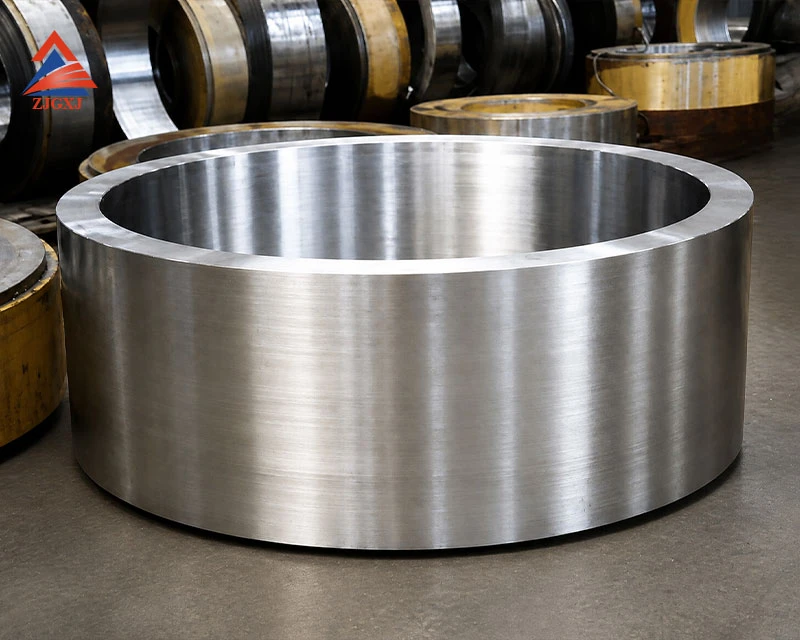
As a supplier, I source my ring gears from high-grade forged steel, not cast steel (cast gears are prone to hidden flaws that crack under the constant torque of wind). Forged rings hold their shape better under extreme stress, which is why you'll find them in every major modern turbine. I specialize in wind turbine ring gears, but I also supply other industrial forged components-check out our range of forged rings, industrial ring gear, oil and gas forgings, and industrial forgings if you're working on other heavy machinery projects. All our parts are precision-machined to within 0.02mm tolerance, so the tooth counts and gear profiles are exact, which means the speed ratio is consistent every single time.
Wait, a common question I get from new engineers: why not just use a higher ratio ring gear? It makes sense at first-higher ratio = faster generator, right? But there's a trade-off. Higher ratio gears create more friction, which means more energy is lost as heat. Turbines in hot climates, like the Southwest US or parts of Europe, can overheat if their gearbox is working too hard from an overly high speed ratio. We work with each farm to calculate the optimal ratio based on their local wind speed, temperature, and turbine model. For a turbine in a consistent 7 m/s wind with an average global temperature, a 95:1 total ratio (with a 28:1 ring gear stage) is ideal-balances speed, torque, and energy loss. For a cold, low-wind location like northern Canada, a 105:1 ratio (32:1 ring gear) works better to get the generator up to speed in slower air.
I also want to address a myth I hear all the time: that the speed ratio is only about power output. It's also about component lifespan. A ring gear with a ratio that's too low means the pinion gears have to work harder to turn the larger ring, which wears out both the pinion and ring gear much faster. I've seen turbines replace their ring gears every 5 years when the ratio was mismatched, instead of the standard 20+ year lifespan. That's a huge cost for a farm-replacing a ring gear can run $50,000 to $100,000, plus downtime costs of missing weeks of power generation. Getting the speed ratio right from the start cuts those maintenance costs dramatically.
Let's get into the technical side a little more, to clear up confusion between different gear types. The ring gear in a planetary gear set (the most common design for modern wind turbines) is stationary, right? Wait, no-there are two types of planetary ring gears: fixed and rotating. Fixed ring gears are the most common, because they create the highest speed increase. When the ring gear is fixed, the sun gear in the center turns, driving the planet gears that orbit around it, and the carrier that holds the planets spins to drive the rest of the gearbox. The ratio here is (number of ring gear teeth + number of sun gear teeth) / number of sun gear teeth. That's why the tooth count is so critical-even a 1-tooth difference changes the ratio by 1 or 2 points, which adds up over each gear stage. Rotating ring gears are used in some small offshore turbines, but they're less common because they add more weight to the nacelle (the housing at the top of the tower), which increases structural costs.
As someone who's been in this space for years, I've watched wind turbine technology evolve, and the speed ratio of the ring gear has kept pace. Ten years ago, most onshore turbines used total ratios of 80:1 to 90:1, but with larger blades (now 50+ meters long, up from 30 meters a decade ago) that spin slower, the ratio has crept up to 95:1 to 110:1. Offshore turbines are even bigger-some 10 MW turbines have total ratios over 120:1, with ring gear stages of 35:1 or higher. That higher ratio is needed because offshore winds are faster and more consistent, so the turbine needs to convert that steady, slow rotation into enough speed to generate massive power.
I always tell customers to ask three questions when evaluating a ring gear supplier: Do you use forged steel, not cast? Can you provide the exact tooth count and ratio calculated for my turbine model? What testing do you do to confirm the ratio is accurate? The ring gear I supply goes through three layers of testing: first, dimensional checks to verify tooth count and size, then run-out testing to make sure the gear spins evenly, then load testing to confirm it can handle the torque of full power generation. No part leaves our facility without those tests, because I know how much is riding on getting that ratio right.
Recently, I worked with a wind farm developer building a project in Texas, where average wind speed is 8 m/s and summer temperatures hit 38°C. They initially ordered ring gears with a 30:1 stage ratio, but after running their wind model, we realized that would create too much heat in the gearbox. We adjusted the ratio to 27:1, which still gave them the total speed they needed, but reduced friction by 12%-resulting in 7% higher overall energy output and lower maintenance costs. That's the kind of tailored solution I offer, not just standard parts.
If you're a wind farm operator, turbine engineer, or project developer reading this, you know that every decimal point in speed ratio, every millimeter of gear tooth, and every pound of forged steel adds up to real revenue. The wind turbine ring gear isn't just a gear-it's the link between the wind's power and the electricity that powers homes and businesses. Getting its speed ratio right isn't a technical detail; it's the difference between a turbine that hits its promised performance and one that underdelivers.

Whether you're building a new wind farm, replacing a worn component, or optimizing an existing turbine's performance, the right ring gear with the correct speed ratio is critical. I've supplied parts for projects across North America and Europe, and I'm here to help you calculate, source, and test the exact ring gear you need. If you have questions about custom ring gears, speed ratio calculations, or other forged components for wind energy, get in touch to discuss your project.