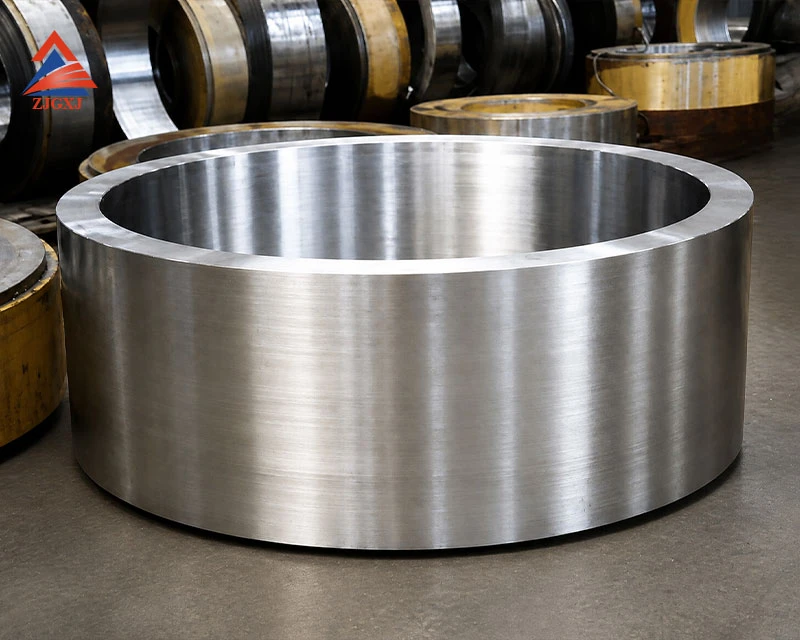
Hey there! I'm a supplier of Forged Rings, and today I'm super stoked to walk you through the process of forging a ring. It's a fascinating journey from raw material to a high - quality finished product, and I can't wait to share it with you.
Step 1: Material Selection
The very first step in forging a ring is choosing the right material. This decision depends on the specific application of the ring. For instance, if it's for Industrial Ring Gear, we might opt for alloy steel. Alloy steel is known for its high strength and durability, which are crucial for gears that need to withstand heavy loads and constant wear and tear.
On the other hand, Oil and Gas Forgings often require materials that can resist corrosion and high pressures. Stainless steel and nickel - based alloys are popular choices in this industry. They have excellent corrosion resistance, ensuring the longevity of the forged rings even in harsh underwater or high - temperature environments.
For Wind Turbine Ring Gear, we need materials with good fatigue resistance. Since wind turbines operate continuously, the rings need to endure repeated stress cycles. High - quality carbon steel or specialized alloy steels are commonly used here to meet these requirements.
Step 2: Heating the Material
Once we've selected the appropriate material, it's time to heat it up. Heating is a critical step as it makes the metal malleable. We heat the material in a furnace to a specific temperature, which varies depending on the type of metal. For most steels, the forging temperature ranges from about 1,000°C to 1,200°C.
At this high temperature, the metal loses its brittleness and becomes easier to shape. We closely monitor the temperature using thermocouples to ensure that it stays within the optimal range. If the metal is not heated enough, it might crack during forging. On the other hand, overheating can lead to grain growth in the metal, reducing its strength and other mechanical properties.
Step 3: Initial Shaping
With the heated metal ready, we move on to the initial shaping process. There are a few different methods we can use, depending on the size and complexity of the ring. One common method is open - die forging. In open - die forging, the metal is placed between two flat or shaped dies, and a hammer or a press applies force to deform the metal.
We start by creating a rough shape that's close to the final dimensions of the ring. This initial shaping helps to distribute the metal evenly and identify any potential flaws in the material. For larger rings, we might use a hydraulic press that can apply a massive amount of force. Smaller rings can be shaped using a mechanical hammer, which provides quick and repetitive blows to shape the metal.
Step 4: Ring Expansion
After the initial shaping, we move on to ring expansion. This step is crucial for creating the circular shape of the ring. We use a mandrel, which is a cylindrical tool placed inside the partially - formed ring. As we apply force to the outer surface of the ring, it expands around the mandrel, gradually increasing its diameter and reducing its wall thickness.
This process is carefully controlled to ensure that the ring has a uniform thickness and diameter. Any unevenness in the ring can lead to imbalances in its performance, especially in applications like gears or bearings. We measure the dimensions of the ring at regular intervals during the expansion process to make sure it meets the required specifications.
Step 5: Final Forging
Once the ring has reached the desired diameter and thickness during the expansion process, we perform the final forging. This step is all about refining the shape and improving the mechanical properties of the ring. We use dies that are specifically designed to create the detailed features of the ring, such as teeth for gears or grooves for bearings.
The final forging process also helps to align the metal grains in a specific direction, which enhances the strength and durability of the ring. By applying precise pressure and controlling the forging speed, we can ensure that the ring has the right balance of strength and toughness.
Step 6: Heat Treatment
After the final forging, the ring undergoes heat treatment. Heat treatment is essential for improving the metal's hardness, toughness, and other mechanical properties. There are different types of heat treatment processes, such as annealing, quenching, and tempering.
Annealing involves heating the ring to a specific temperature and then cooling it slowly. This process relieves internal stresses in the metal and makes it more ductile. Quenching, on the other hand, involves rapid cooling of the ring in a quenching medium, such as water or oil. This makes the ring very hard, but it can also make it brittle. That's why we follow quenching with tempering, which involves heating the ring to a lower temperature and then cooling it slowly. Tempering reduces the brittleness of the ring while maintaining its hardness.
Step 7: Machining and Finishing
Once the heat treatment is complete, the ring is ready for machining and finishing. Machining is used to achieve the final dimensions and surface finish of the ring. We use various machining processes, such as turning, milling, and grinding.
Turning is used to remove excess material from the outer and inner diameters of the ring, making it more precise. Milling is used to create keyways, slots, or other features on the ring. Grinding is used to achieve a smooth surface finish, which is important for applications where the ring needs to fit precisely with other components.
After machining, we perform finishing operations, such as polishing or coating. Polishing gives the ring a smooth and shiny appearance, while coating can provide additional protection against corrosion.
Step 8: Quality Control
Throughout the entire forging process, we have strict quality control measures in place. We conduct various tests to ensure that the ring meets the required standards. These tests include non - destructive testing methods, such as ultrasonic testing and magnetic particle testing, to detect any internal flaws or surface cracks.
We also perform mechanical property testing, such as tensile testing and hardness testing. Tensile testing measures the strength and ductility of the ring by applying a pulling force until it breaks. Hardness testing determines the hardness of the ring using methods like the Rockwell or Brinell hardness tests. Only after passing all these tests is the ring considered ready for delivery.
Connect with Us for Your Forged Ring Needs
If you're in the market for high - quality Forged Rings or Industrial Forgings, we're here to help. We have the expertise and experience to produce forged rings that meet your specific requirements. Whether you need rings for the oil and gas industry, wind turbines, or any other industrial application, we can provide you with reliable solutions.
Get in touch with us to discuss your project and let's start a fruitful procurement and collaboration journey together!